When Hult Got Curious About AI
by Favour Patrick ·
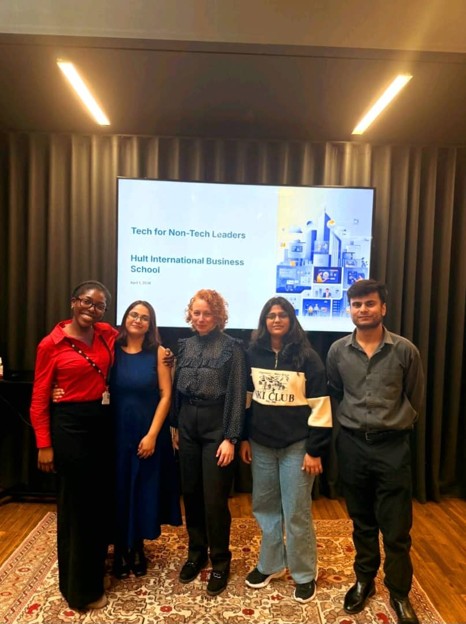
What Happened at Hult
Eleni Lialiamou led a session for the Hult Tech Society titled "Tech for Non-Tech Leaders." The room was full of business students' people who work with strategy, people, and ideas, not necessarily code. The conversation that followed was anything but surface level.
After the main session, the group moved into one-on-one discussions over boba. That combination, structured thinking followed by real conversation, turned out to be the format that brought it all together.
The Idea That Anchored the Room
"We don't want to outsource thinking. We want to enhance it."
That tension is real for most people when they first encounter AI tools. There is a fear that using AI means doing less thinking. The session flipped that. When AI handles the repetitive and the mechanical, it frees you to do more of the thinking that actually matters.
From there, Eleni walked the group through a way of looking at how AI fits into any kind of work. Not as a checklist, but as a way of thinking through where you are and what you are actually trying to do.
It starts with discovery: identifying the problem worth solving, and using AI to research, synthesize, and surface patterns faster than you could alone. Then comes design, shaping the solution. Tools like Lovable let you describe an idea and watch it take form; no technical background required. Development follows, and the barrier to prototyping has dropped significantly. "Everyone is now a programmer" was one of the session's boldest claims, and the live demo made it hard to argue. Finally, deployment: getting something in front of real people. The distance from idea to reality has collapsed, and that speed is a genuine advantage for anyone willing to use it.
What This Looks Like in Practice
The session used Lovable as a live example. Participants watched an idea move from a text description to something tangible in real time. The reaction in the room was the kind that happens when something goes from abstract to obvious.
The key insight was not about the tool itself. It was about what the tool revealed: that innovation is no longer blocked by whether or not you can write code. It is blocked by whether or not you can think clearly, ask good questions, and move with intention.
Try It Now
Whether you were in that room or are coming to this fresh, here is where to start. Think about the problem in your work that costs you the most time, and ask an AI tool what solutions already exist. Take an idea you have shelved because you lacked technical skills and use Lovable to describe it and see what it builds. Look at your week and identify tasks that feel mechanical content, marketing, PR, synthesis, strategy and let Athena do the heavy lifting. Athena is Kimolian's AI agent: your critical friend, writing partner, and strategist in one, built to draft, question, and sharpen your thinking before it reaches anyone else. And if you lead a team, run them through that way of thinking: what are you discovering, designing, developing, and deploying right now?
Takeaway
The Hult session was a live example of what happens when AI is introduced as a thinking partner, not a shortcut. Non-technical professionals can build, prototype, and innovate when given the right lens and the right tools. Human skills like creativity, empathy, and critical thinking become more valuable, not less, when AI handles the rest.
The real edge is how you think, not just what tools you use. AI boosts productivity, which creates space for more ambition. The barrier to building has dropped. And as the session put it plainly: AI will not replace you, but a person using AI well might.
If that landed, Kimolian AI runs programs built around exactly this kind of thinking. Practical, human, and designed for people who want to use AI with intention rather than just keep up with it.

Favour Patrick
Favour Patrick has a background in economics and works in the product and AI space. Through product research, product thinking, content, and AI-enabled workflows, she tells stories about the people building better products and businesses
LinkedIn →