Good memories, no proof: how Shuli built Yush to capture what events usually lose
by Favour Patrick ·
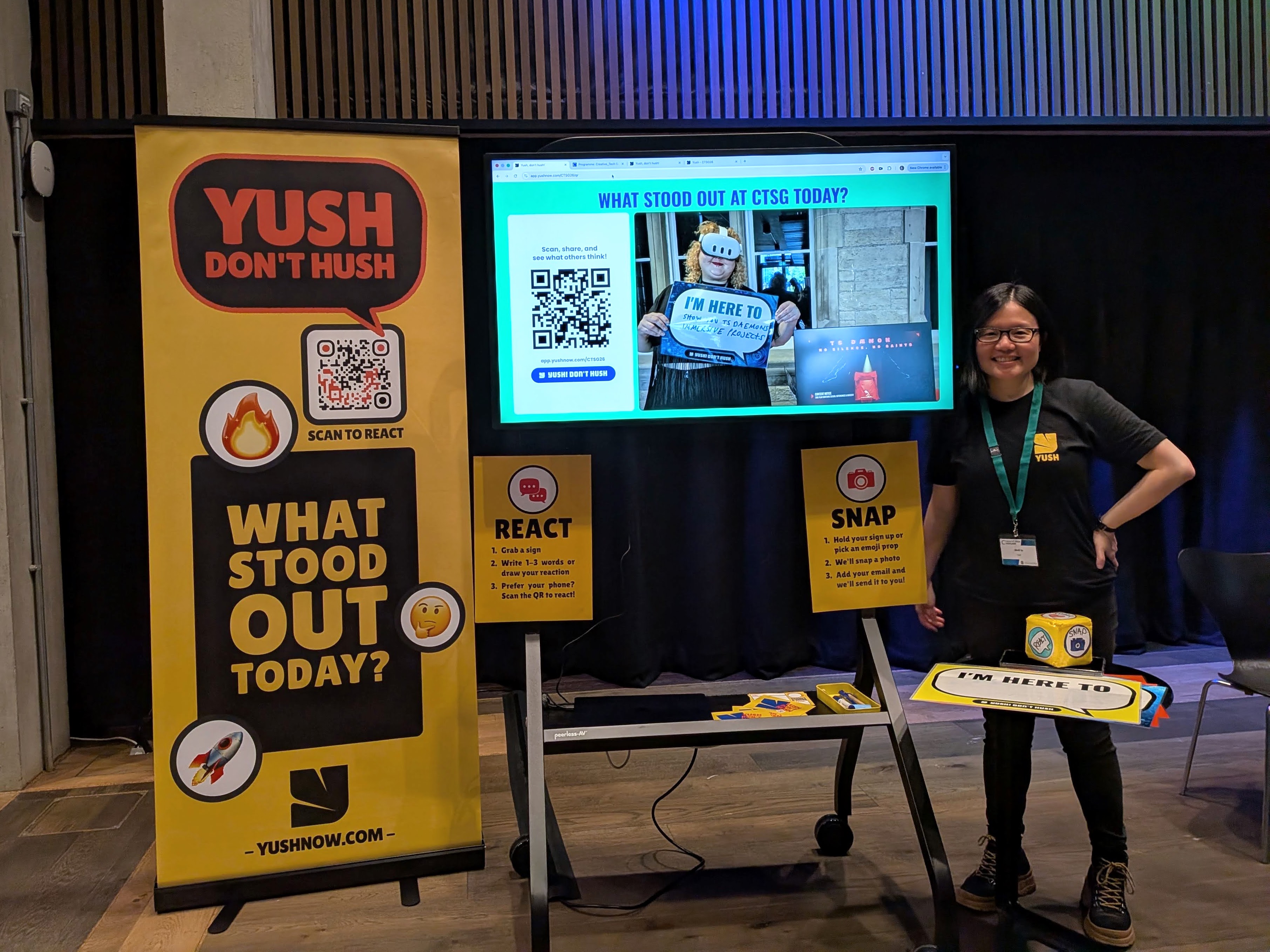
A product leader with a psychology background used rapid prototyping, paid pilots, and real-world event delivery to turn a market insight into Yush - a platform for capturing live event reactions and turning them into proof organisers can actually use.
“Interviews helped, but I was still outside the room. I needed something useful to offer organisers, not just more questions. So I built an early version of Yush and used it to deliver feedback capture as a service.”
Shuli Yu - Founder, Yush
The Situation
Shuli Yu did not set out to build “better event feedback.”
She kept running into the same gap from different angles.
She came from the reviews world, where she had helped grow a large product-reviews platform and seen both the power and the limits of customer feedback at scale. Star ratings, NPS scores, and polished summaries could look useful on the surface, but they often failed to explain what people actually felt or why.
What interested her more were the quicker, more human signals: reactions, photos, short comments, and the small details that reveal what really landed.
Later, after moving to London and going to startup conferences, she noticed a different version of the same problem. Before an event, there was always plenty of noise - organisers, sponsors, and speakers all promoting it. But inside the room, something more interesting was happening: people reacting in real time, photographing slides, sharing moments, and taking candid pictures with people they had just met.
The most useful signal was in the room, but almost none of it flowed back to organisers in a useful, reusable way.
Shuli felt the pain even more directly when helping to run networking events herself. Like most organisers, the team was too busy setting up, hosting, and keeping the energy in the room to chase feedback forms or gather the photos, quotes, and reactions they wished they had afterwards. They left with good memories, but no proof, no assets, and no insights to make the next event better.
That was the shift.
What organisers were missing was not just feedback. They were missing proof: proof that the event worked, proof of what landed, and proof they could reuse afterwards in recaps, reports, sponsor updates, funder conversations, and future planning.
What We Did
Built something small enough to test
Shuli started with the sensible route: surveys, interviews, and early conversations. But live events were a new market, and traditional discovery only got her so far.
She needed a way into the room.
Through the Women in Tech & Innovation course, delivered by Capital City College Group and Kimolian, Shuli joined the Kimolian community and met other women in product - including Paula, who shared in a skillshare session how she was using tools like Lovable to prototype real web apps faster. That opened up a practical route: build something small, useful, and testable, then use it to create value upfront.
So she built an early version of Yush and started offering live feedback capture as a service. The point was not to build the final product. It was to get close enough to the truth to see what actually worked.
Learned what mattered in the room
The early pilots taught her something quickly:
A QR code is not a strategy. The response moment is.
What mattered was not just whether a survey link existed. It was the question, the timing, the prompt, the signage, the energy around the ask, and what organisers got back afterwards.
That became especially clear at TecTonic Night Summit, a busy event with mentoring, exhibitors, interactive showcases, performances, and networking all happening at once. As Nick Murray, Director of TecTonic, put it, when there is that much going on, it is hard to truly take the temperature in the room and know what is landing in the moment.
Yush helped capture structured live reactions while the event was still happening. The value was not just that feedback was collected. It was that the signal became usable. Nick later described having the Yush reactions report open and pulling material directly into an impact report.
Not feedback that disappears. Feedback that becomes proof.
Turned field learning into product
That fieldwork shaped Yush.
Not a generic feedback tool. Not a decorative add-on. A product built around the reality of live events: organisers are busy, attention is fragmented, and useful detail disappears fast if it is not captured in the moment.
The service model gave Shuli a way to learn what organisers actually needed before overbuilding the product. It also revealed what had to become repeatable: clearer setup, better prompts, stronger organiser workflows, live galleries, reports, and outputs people could reuse afterwards.
As Yush matured, the early rapid prototype evolved into a more self-serve product with a stronger technical foundation behind the scenes.
Outcomes
- Built an early version of Yush quickly enough to test in real events
- Used live feedback capture as a service to enter a new market, win paid pilots, and learn from real organiser behaviour
- Identified a core product truth: the response moment matters more than the QR code alone
- Helped organisers capture audience signal that would otherwise have been lost
- Turned live reactions into reusable outputs: insight, quotes, galleries, photos, and stakeholder-ready proof
- Created material organisers could use in impact reports, recaps, funder updates, and future event planning
- Shaped a clearer Yush proposition: event feedback and proof, captured live
Why It Matters
What makes this story interesting is not just that Shuli built something quickly, it is that she used speed to get closer to the truth.
Instead of spending a year polishing a product for a market she was still learning, she built something small enough to test, useful enough to sell, and real enough to show her what organisers actually needed.
And what they needed was not “better feedback.”
They were buying proof.
Proof of what landed. Proof of what people noticed. Proof they could reuse with sponsors, funders, partners, leadership, or future attendees. Something stronger than a weak post-event survey and more grounded than a polished LinkedIn recap.
That is what Yush - https://yushnow.com/ was built to capture: real reactions, while the moment is still live, turned into something organisers can actually use.
Curious about how AI tools could work for your business? Reach out — we'd love to show you what's possible.

Favour Patrick
Favour Patrick has a background in economics and works in the product and AI space. Through product research, product thinking, content, and AI-enabled workflows, she tells stories about the people building better products and businesses
LinkedIn →